





Excavator Hydraulic Power Demolition Pulverizer
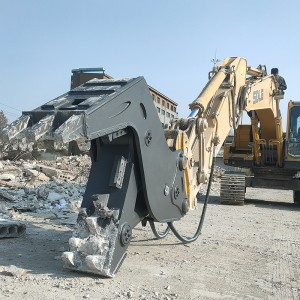
The Excavator Hydraulic Power Demolition Pulverizer (referred to as "pulverizer" below) is a heavy-duty hydraulic attachment designed for excavators, specialized in crushing, pulverizing, and separating hard materials such as concrete, rock, and reinforced steel structures. Unlike standard hydraulic breakers that rely on high-frequency impact, the pulverizer uses "clamping + shearing + crushing" composite actions to break large materials into small, uniform fragments—making it a core tool in construction demolition, infrastructure renovation, and construction waste recycling. By integrating with the excavator’s hydraulic system, it delivers adjustable high torque, replacing traditional mechanical crushing methods and significantly improving the efficiency of material processing while reducing dust and noise pollution.1. General Definition and Core Function
The Excavator Hydraulic Power Demolition Pulverizer (referred to as "pulverizer" below) is a heavy-duty hydraulic attachment designed for excavators, specialized in crushing, pulverizing, and separating hard materials such as concrete, rock, and reinforced steel structures. Unlike standard hydraulic breakers that rely on high-frequency impact, the pulverizer uses "clamping + shearing + crushing" composite actions to break large materials into small, uniform fragments—making it a core tool in construction demolition, infrastructure renovation, and construction waste recycling. By integrating with the excavator’s hydraulic system, it delivers adjustable high torque, replacing traditional mechanical crushing methods and significantly improving the efficiency of material processing while reducing dust and noise pollution.
2. Key Structural Components
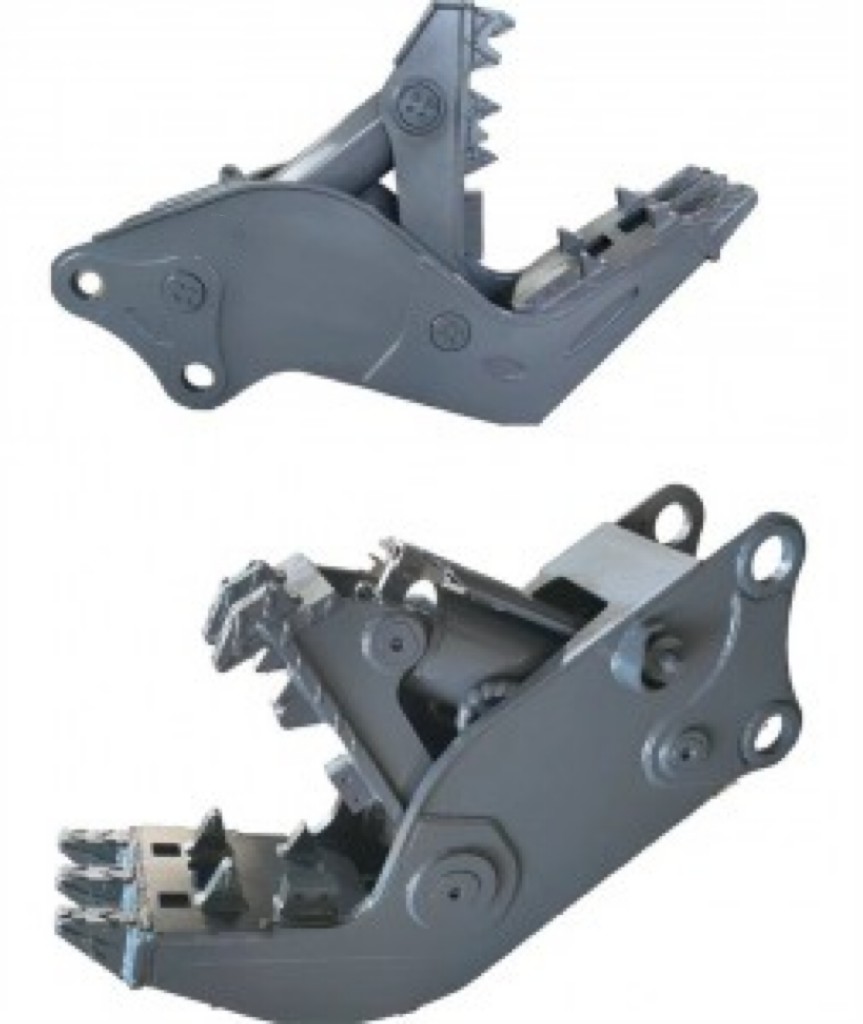
2.1 Pulverizer Body (Frame)
Material and Durability: The main frame is constructed from high-strength quenched and tempered steel (e.g., Q690E or S700MC), with a minimum yield strength of 690 MPa and excellent low-temperature impact resistance (-40℃ impact energy ≥34 J). This ensures the frame can withstand the cyclic stress of clamping hard concrete (compressive strength ≥C60) without deformation. Critical stress points—such as the connection to the excavator arm and the hinge of the movable jaw—are reinforced with double-layer steel plates or wear-resistant alloy welding (e.g., ER50-6 welding wire), extending the frame’s service life to 2,000–3,000 operating hours.
Structural Design: Adopting a "box-type closed frame" structure, the body minimizes flexing during high-pressure clamping. The overall weight is balanced: for mid-sized excavators (15–25 tons), the pulverizer weighs 1.2–2.5 tons, avoiding excessive load on the excavator’s arm. Additionally, the frame is designed with a "dust-proof and anti-clogging" structure—gaps between the movable and fixed jaws are sealed with rubber gaskets to prevent concrete debris from entering the hinge and affecting movement.
2.2 Hydraulic Drive System
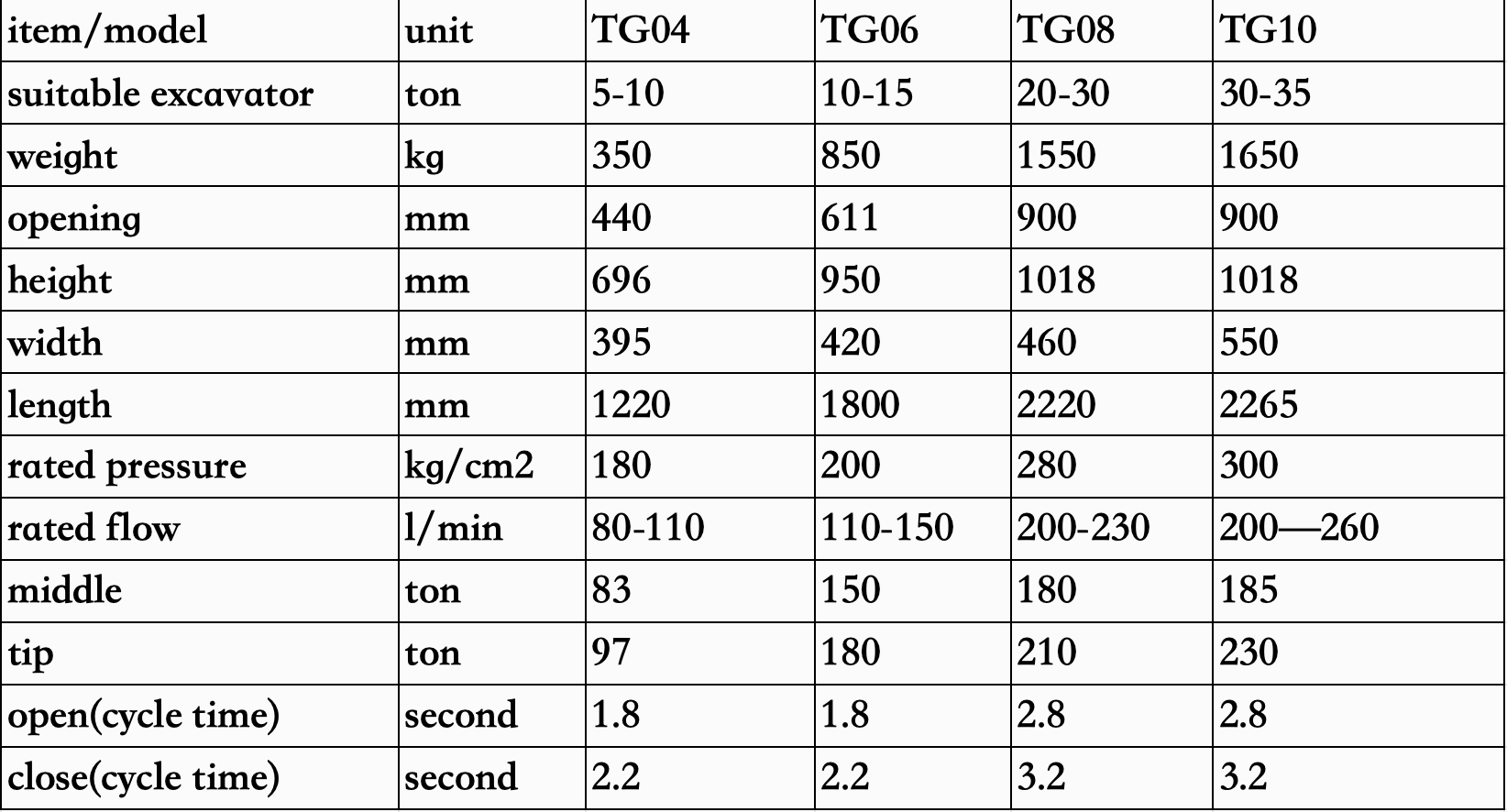
Dual Hydraulic Cylinders: Equipped with two horizontal parallel hydraulic cylinders (bore diameter: 100–160 mm; stroke: 250–400 mm), which are the core power source for jaw movement. The cylinder barrels are made of 27SiMn seamless steel pipes, and the piston rods are chrome-plated (plating thickness ≥0.05 mm) to resist corrosion and wear. Operating at a working pressure of 28–35 MPa, the cylinders generate a clamping force of 180–450 kN—for example, a 20-ton excavator-mounted pulverizer can produce 320 kN of force, enough to crush a 500 mm × 500 mm concrete block into fragments smaller than 100 mm in 5–8 seconds.
Hydraulic Control Valves: Integrated with a "pressure relief + one-way check" dual-valve system. The pressure relief valve limits the maximum working pressure to 38 MPa, preventing cylinder damage due to overloading; the one-way check valve locks the hydraulic oil in the cylinder when the system pressure drops (e.g., hose leakage), avoiding accidental opening of the jaws and ensuring operational safety. High-end models add a proportional flow valve, allowing operators to adjust the jaw closing speed (50–150 mm/s) according to material hardness—slower for reinforced concrete, faster for ordinary rock.
2.3 Jaw Mechanism (Movable + Fixed Jaws)
Jaw Material and Tooth Design:
Fixed Jaw: Welded with wear-resistant steel plates (AR500/AR600), which have a Brinell hardness of 500–600 HB, 3–4 times more wear-resistant than ordinary steel. The inner side is designed with "triangular convex teeth" (tooth height: 20–30 mm; tooth spacing: 50–80 mm) to increase friction with materials and prevent slipping during clamping.
Movable Jaw: Adopts a "replaceable tooth plate" design—when the teeth are worn (wear depth ≥10 mm), the tooth plate can be removed and replaced with bolts, reducing maintenance costs by 40% compared to replacing the entire jaw. For reinforced concrete, some models are equipped with "shear teeth" at the jaw tips, which can cut through 12–20 mm diameter steel bars while crushing concrete, realizing "concrete-steel separation" in one step.
Jaw Opening and Adjustment: The maximum jaw opening ranges from 600–1,200 mm, adapting to different sizes of materials (e.g., 800 mm opening for crushing wall panels, 1,200 mm for breaking large foundation piles). Some pulverizers have an "adjustable jaw gap" function—by replacing the shim between the jaw and the frame, the minimum gap can be set to 30–80 mm, controlling the particle size of the crushed material (e.g., 50 mm gap for producing recycled aggregate for road base).
2.4 Mounting and Connection System
Quick-Coupler Compatibility: Designed to match standard excavator quick couplers (ISO 13031 or OEM custom types), enabling tool changes in 5–10 minutes. The mounting plate is processed with high-precision CNC machining, ensuring the pin holes (diameter: 40–60 mm) are coaxial with the excavator’s arm, reducing vibration during operation.
Hydraulic Pipeline Connection: Uses high-pressure spiral rubber hoses (DN20–DN32) with a working pressure of 40 MPa, covered with a polyurethane wear-resistant sleeve to prevent damage from gravel impact. The quick-disconnect couplings (ISO 7241-1 B-series) have a self-sealing function—when disconnected, they can prevent hydraulic oil leakage, avoiding environmental pollution and oil waste.
3. Working Principle
3.1 Hydraulic Power Transmission
The excavator’s hydraulic pump draws oil from the tank and pressurizes it to 28–35 MPa. The high-pressure oil is delivered to the pulverizer’s hydraulic cylinders through hoses and control valves. When the operator activates the "jaw close" lever, oil enters the rodless cavity of the cylinders, pushing the pistons outward to drive the movable jaw toward the fixed jaw; when activating "jaw open," oil enters the rod cavity, pulling the pistons back to open the jaws. The entire process relies on the excavator’s hydraulic system to control pressure and flow, ensuring stable and controllable jaw movement.
3.2 Crushing Action Process
Material Feeding: The operator maneuvers the excavator to align the open jaws with the target material (e.g., a concrete beam or rock block), ensuring the material is centered between the jaws to avoid uneven force.
Clamping and Pre-Crushing: The jaws close to clamp the material, and the hydraulic cylinders apply gradual pressure. For brittle materials like concrete, micro-cracks first appear on the surface; for reinforced concrete, the steel bars are bent and compressed by the jaw teeth.
Shearing and Pulverizing: As pressure increases, the jaw teeth penetrate the material, and the movable jaw continues to move, shearing the material along the weak points (e.g., concrete joints, steel bar welds). For large materials, the process is repeated 2–3 times until the fragments are smaller than the jaw gap.
Material Discharge: The jaws open, and the crushed fragments fall into the collection device (e.g., a dump truck or hopper). If steel bars are present, they are retained by the jaw teeth and can be manually removed or further sheared into short sections.
4. Classification by Application
4.1 Concrete Demolition Pulverizer
Key Features: Focus on "concrete crushing + steel separation," with shear teeth at the jaw tips and a narrow jaw gap (30–50 mm). The frame is reinforced at the jaw hinge to withstand the impact of reinforced concrete.
Application Scenarios: Demolition of buildings (e.g., breaking walls, beams, and columns), processing of construction waste (crushing concrete blocks into recycled aggregate), and renovation of old factories (removing reinforced concrete foundations). For example, in the demolition of a 10-story reinforced concrete building, it can process 50–80 tons of concrete per hour, and the separated steel bars have a recovery rate of over 95%.
4.2 Rock Crushing Pulverizer
Key Features: Thickened jaw plates (AR600 wear-resistant steel), larger jaw opening (800–1,200 mm), and higher clamping force (350–450 kN). The jaw teeth are designed with a "blunt tip" to avoid excessive wear when crushing hard rock (e.g., granite, basalt).
Application Scenarios: Quarry secondary crushing (crushing large rock blocks into 50–100 mm aggregates for concrete), road construction (breaking bedrock during roadbed excavation), and tunnel construction (processing muck into recyclable stone). A 25-ton excavator-mounted rock pulverizer can crush 80–120 tons of granite per hour.
4.3 Light-Duty Pulverizer
Key Features: Lightweight design (800–1,200 kg) for small excavators (6–12 tons), with a jaw opening of 400–600 mm and a clamping force of 80–150 kN. The body uses a simplified structure to reduce weight, suitable for narrow spaces.
Application Scenarios: Residential renovation (crushing small concrete piles or old floor slabs), garden construction (breaking stone barriers), and municipal engineering (processing sidewalk concrete blocks). For example, in the renovation of an old residential area, it can crush 10–20 tons of concrete per hour without damaging surrounding buildings.
5. Practical Applications and Advantages
5.1 Construction Demolition: Efficient and Environmentally Friendly
High Efficiency: Compared to manual crushing (1–2 tons/hour) or mechanical hammers (20–30 tons/hour), the pulverizer’s processing capacity reaches 50–120 tons/hour, shortening the demolition cycle by 60–70%. For example, demolishing a 5,000 m² factory building takes only 3–5 days with a pulverizer, compared to 10–15 days with traditional methods.
Low Pollution: The "clamping + crushing" mode produces less dust than impact breakers—dust concentration can be controlled below 5 mg/m³ (meeting national environmental standards) when used with a water spray system. Additionally, the operating noise is 75–85 dB, 10–15 dB lower than breakers, reducing noise pollution in urban areas.
5.2 Construction Waste Recycling: Resource Reutilization
Recycled Aggregate Production: The pulverizer can crush concrete waste into 30–80 mm recycled aggregate, which meets the quality requirements of GB/T 25177-2010 《Recycled Aggregate for Concrete》. Using this aggregate to produce concrete blocks or road base materials reduces the demand for natural sand and gravel by 30–50%, saving natural resources.
Steel Recovery: When crushing reinforced concrete, the pulverizer separates steel bars from concrete, with a recovery rate of over 95%. The recovered steel bars can be remelted into new steel products, reducing scrap steel waste and realizing a "circular economy."
5.3 Infrastructure Construction: Cost Reduction
On-Site Material Processing: In road or bridge construction, the pulverizer can process on-site rock or concrete waste into usable aggregates, eliminating the need for long-distance transportation of raw materials and waste. This reduces transportation costs by 40–60% and shortens the construction period.
Flexible Operation: Compared to fixed crushing equipment (e.g., jaw crushers), the pulverizer can move with the excavator, adapting to scattered construction sites (e.g., mountain road construction, tunnel muck processing). It does not require site preparation (e.g., foundation pouring), saving infrastructure investment.
6. Operational and Maintenance Considerations
6.1 Excavator Matching Requirements
Weight Compatibility: The pulverizer’s weight should not exceed 15–20% of the excavator’s operating weight (e.g., a 15-ton excavator should use a pulverizer weighing ≤2.5 tons). Excessive weight will cause the excavator’s arm to sag, affecting operation stability and accelerating arm wear.
Hydraulic System Matching: The excavator’s hydraulic flow should be 30–80 L/min (matching the pulverizer’s flow requirement). If the flow is too low, the jaw movement speed will slow down, reducing efficiency; if too high, the hydraulic system will overheat, damaging the pump and valves.
6.2 Routine Maintenance
Lubrication: Grease the jaw hinge and cylinder pins every 4 hours of operation, using lithium-based grease (NLGI 2) to reduce friction. Check the grease level in the swivel joint (if equipped) weekly and add grease if insufficient.
Component Inspection: Inspect the jaw teeth and wear plates daily—replace them when the wear depth exceeds 1/3 of the original thickness. Check the hydraulic hoses and couplings for leaks or cracks weekly; replace damaged hoses immediately to avoid pressure loss.
Hydraulic Oil Maintenance: Use hydraulic oil that meets the excavator’s requirements (e.g., ISO VG 46). Change the oil and oil filter every 1,000 operating hours to prevent oil contamination from affecting the pulverizer’s performance.
6.3 Safety Operation Rules
Operator Training: Operators must be trained to master the pulverizer’s operation method, including jaw opening/closing control and pressure adjustment. They should understand the emergency stop procedure (e.g., pressing the emergency valve to cut off hydraulic oil supply) in case of malfunctions.
On-Site Safety: Before operation, clear the site of personnel and obstacles to prevent fragments from injuring people or damaging equipment. Do not crush materials beyond the jaw’s capacity (e.g., avoid clamping oversized rock blocks that may cause the frame to deform). When working on slopes, ensure the excavator is stable to prevent tipping.