


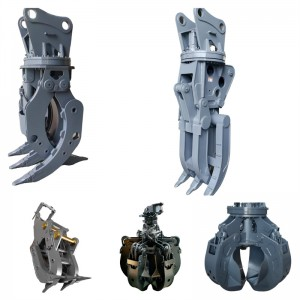
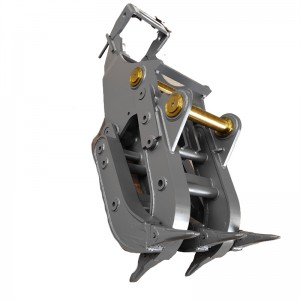
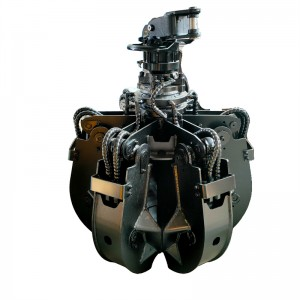


Excavator Hydraulic Rotating Steel Grab
The Excavator Hydraulic Rotating Steel Grab is a specialized hydraulic attachment engineered for excavators, dedicated to efficiently gripping, lifting, and transferring ferrous materials—primarily scrap steel, steel billets, steel plates, and steel structures. Unlike standard fixed grabs, it integrates a 360° hydraulic rotation system, enabling flexible angle adjustment to handle irregularly shaped or scattered steel materials. This makes it a core tool in industries such as scrap metal recycling, steel mills, and heavy machinery dismantling. By leveraging the excavator’s hydraulic power, it delivers adjustable clamping force (80–500 kN) to securely hold steel materials of varying weights (from 0.5 tons to 20 tons), replacing labor-intensive manual handling or crane-mounted grabs, and significantly improving loading/unloading efficiency and operational safety.1. General Definition and Core Function
The Excavator Hydraulic Rotating Steel Grab is a specialized hydraulic attachment engineered for excavators, dedicated to efficiently gripping, lifting, and transferring ferrous materials—primarily scrap steel, steel billets, steel plates, and steel structures. Unlike standard fixed grabs, it integrates a 360° hydraulic rotation system, enabling flexible angle adjustment to handle irregularly shaped or scattered steel materials. This makes it a core tool in industries such as scrap metal recycling, steel mills, and heavy machinery dismantling. By leveraging the excavator’s hydraulic power, it delivers adjustable clamping force (80–500 kN) to securely hold steel materials of varying weights (from 0.5 tons to 20 tons), replacing labor-intensive manual handling or crane-mounted grabs, and significantly improving loading/unloading efficiency and operational safety.
2. Key Structural Components
2.1 Grab Body (Frame)
Material and Durability: The main frame is constructed from high-strength low-alloy (HSLA) steel, typically grades like Q690 or S700MC, with a minimum yield strength of 690 MPa and excellent impact resistance (-40℃ impact energy ≥34 J). This ensures the frame can withstand the heavy load of steel materials (e.g., 10-ton scrap steel bundles) without deformation. Critical stress points—such as jaw hinges and rotation joint connections—are reinforced with wear-resistant steel plates (AR400/AR500), extending the frame’s service life to 3,000–4,000 operating hours.
Structural Design: Adopting a "triangular truss welded structure," the body balances structural strength and weight reduction. For mid-to-large excavators (15–40 tons), the grab weighs 1.8–4.5 tons, avoiding excessive load on the excavator’s arm. Additionally, the frame is designed with a "debris drainage gap" between the jaws—preventing small steel scraps from jamming the jaw hinges and ensuring smooth opening/closing.
2.2 Jaw Mechanism (Gripping Component)
Jaw Structure and Material: Equipped with 2–4 curved or straight jaws (depending on the model), made of wear-resistant alloy steel (e.g., 40CrNiMoA) with a surface hardness of HRC 45–50. The jaw inner side is designed with "serrated anti-slip teeth" (tooth height: 15–25 mm; tooth spacing: 30–50 mm) to increase friction with steel materials—preventing slippage even when gripping smooth steel plates or round steel bars. For heavy-duty models, the jaw tips are reinforced with tungsten carbide inserts, enhancing wear resistance by 2–3 times when handling sharp-edged scrap steel.
Hydraulic Clamping Cylinders: 2–4 parallel hydraulic cylinders (bore diameter: 80–160 mm; stroke: 200–400 mm) drive jaw movement. The cylinder barrels are made of 27SiMn seamless steel pipes, and piston rods are chrome-plated (plating thickness ≥0.06 mm) to resist corrosion and scratch. Operating at a working pressure of 25–35 MPa, the cylinders generate a clamping force of 80–500 kN—for example, a 25-ton excavator-mounted grab can produce 300 kN of force, securely gripping a 8-ton scrap steel bundle without deformation.
2.3 360° Hydraulic Rotation System
Rotation Motor and Reducer: The core of the rotation system is a low-speed high-torque (LSHT) hydraulic motor (displacement: 400–1,200 mL/r) paired with a planetary gear reducer (reduction ratio: 40:1–80:1). The motor delivers high torque (8,000–25,000 N·m) to drive the grab rotation, with a rotation speed of 3–6 rpm—slow enough for precise positioning (e.g., aligning steel bundles with truck beds) and fast enough to avoid delaying work cycles. The planetary gears are made of 20CrMnTi alloy steel (carburized and quenched to HRC 58–62), ensuring durability under heavy loads.
Sealed Rotation Joint: The rotation joint (connecting the grab body to the excavator arm) adopts a multi-channel sealed structure, using nitrile rubber O-rings and PTFE backup rings to prevent hydraulic oil leakage and dust intrusion. It integrates oil passages for both jaw cylinders and rotation motor, eliminating external hose twisting during rotation. The joint is lubricated with lithium-based grease (NLGI 3) and requires only monthly grease replenishment, reducing maintenance frequency.
2.4 Mounting and Hydraulic Connection
Quick-Coupler Compatibility: Designed to match standard excavator quick couplers (ISO 13031 or OEM custom types), enabling tool changes in 6–10 minutes. The mounting plate is processed with CNC machining, ensuring pin holes (diameter: 40–60 mm) have a coaxiality error ≤0.1 mm—reducing vibration during grabbing and protecting the excavator’s arm hinge.
Hydraulic Pipeline: Uses high-pressure steel wire braided hoses (DN20–DN32) with a working pressure of 40 MPa, covered with a polyurethane wear-resistant sleeve to resist impact from steel scraps. The pipeline has two independent circuits: one for jaw clamping cylinders (controlling opening/closing) and one for rotation motor (controlling 360° rotation). Quick-disconnect couplings (ISO 7241-1 B-series) with self-sealing valves are used—when disconnected, they prevent hydraulic oil leakage, avoiding environmental pollution and oil waste.
3. Working Principle
3.1 Hydraulic Power Transmission
The excavator’s hydraulic pump draws oil from the tank and pressurizes it to 25–35 MPa. The high-pressure oil is split into two circuits via a multi-way valve: one circuit supplies oil to the jaw clamping cylinders, and the other to the rotation motor. The operator controls the oil flow direction and flow rate via the excavator’s control lever—adjusting clamping force (by changing pressure) and rotation speed (by changing flow) according to the weight and shape of the steel material.
3.2 Gripping and Rotation Process
Angle Adjustment: The operator activates the rotation motor to rotate the grab to the optimal angle (e.g., 0° for flat steel plates, 90° for vertical steel columns). The 360° rotation allows the grab to access steel materials in tight spaces (e.g., between scrap piles or inside steel mill workshops) without repositioning the excavator.
Jaw Opening and Positioning: Oil is supplied to the rod cavity of the clamping cylinders, pulling the pistons back to open the jaws. The operator maneuvers the excavator to align the jaws with the target steel material—ensuring the material is evenly distributed between the jaws to avoid unbalanced loading.
Clamping and Lifting: Oil is switched to the rodless cavity of the clamping cylinders, pushing the pistons outward to close the jaws. The serrated teeth bite into the steel material, generating sufficient clamping force to hold it securely. The excavator’s arm then lifts the grab and the steel material to the target height.
Rotation and Unloading: The rotation motor is activated to adjust the grab angle (e.g., rotating 180° to align with the truck bed), and the jaws are opened by reversing the oil flow to the cylinders—unloading the steel material into the truck, storage yard, or processing equipment.
4. Classification by Application
4.1 Scrap Steel Recycling Grab
Key Features: Focus on "grabbing irregular scrap steel," with 3–4 curved jaws (max opening: 800–1,200 mm) to wrap around scattered or bundled scrap steel. The jaws have dense anti-slip teeth (tooth spacing: 30–40 mm) to grip small scrap pieces (≥50 mm) without dropping. Some models add a "hydraulic pressure maintaining valve"—keeping the clamping force stable for 10–15 minutes when lifting heavy scrap bundles, preventing slippage due to oil pressure loss.
Application Scenarios: Scrap metal recycling yards (loading/unloading scrap steel bundles, sorting scattered scrap pieces), demolition sites (grabbing steel structural debris), and waste treatment plants (separating steel from mixed waste). For example, a scrap steel grab can load 15–25 tons of scrap steel into a truck per hour, 2–3 times faster than manual loading.
4.2 Steel Mill Dedicated Grab
Key Features: Designed for "grabbing regular steel products," with 2 straight jaws (max opening: 600–1,000 mm) to grip steel billets (diameter 100–300 mm), steel plates (thickness 10–50 mm), or steel coils (weight ≤15 tons). The jaw inner side is polished to avoid scratching the surface of finished steel products. The rotation system is optimized for high-precision positioning (rotation error ≤1°) to align steel billets with the rolling mill feed port.
Application Scenarios: Steel mills (transferring steel billets between workshops, loading/unloading finished steel products), shipyards (handling steel plates for hull construction), and heavy machinery factories (gripping large steel components for assembly). A steel mill grab can transfer 30–40 steel billets (each 1 ton) per hour, ensuring continuous production in the rolling mill.
4.3 Heavy-Duty Steel Structure Grab
Key Features: Built for "grabbing large steel structures," with 2 thickened straight jaws (jaw thickness: 50–80 mm) and a high clamping force (350–500 kN) to grip steel beams (width ≤600 mm), steel columns (diameter ≤500 mm), or large machinery parts (weight ≤20 tons). The frame is reinforced with double-layer steel plates, and the rotation joint uses a large-diameter bearing (inner diameter ≥150 mm) to withstand heavy loads.
Application Scenarios: Industrial plant demolition (grabbing steel frames, boiler shells), bridge construction (transferring steel girders), and port logistics (unloading large steel components from ships). A heavy-duty grab mounted on a 40-ton excavator can lift a 18-ton steel beam and rotate it 360° smoothly, replacing large cranes in narrow construction sites.
5. Practical Applications and Advantages
5.1 Scrap Metal Recycling: Efficiency Improvement
High Loading Capacity: Compared to manual loading (2–3 tons/hour) or crane-mounted fixed grabs (8–12 tons/hour), hydraulic rotating steel grabs process 15–30 tons of scrap steel per hour—shortening the loading cycle by 60–70%. For a scrap yard handling 100 tons of scrap daily, using a grab reduces the required working time from 10 hours to 4–6 hours.
Flexible Operation: The 360° rotation eliminates the need to reposition the excavator when adjusting the direction of scrap steel—saving 20–30% of operation time compared to fixed grabs. It can also grip scrap steel from irregular piles (e.g., 3-meter-high scrap heaps) without the need for pre-leveling, reducing pre-processing work.
5.2 Steel Mills: Production Continuity
Precision Handling: The high-precision rotation and clamping control ensure steel billets or plates are aligned with processing equipment (e.g., rolling mills, cutting machines) with an error ≤20 mm—avoiding equipment jams caused by misalignment. This reduces production downtime by 15–20% compared to manual handling.
Surface Protection: For finished steel products (e.g., galvanized steel plates), the polished jaw surface and adjustable clamping force prevent scratches or deformation—reducing product defect rates by 8–12% and improving the quality of finished steel.
5.3 Heavy Construction: Space Adaptability
Narrow Space Operation: In narrow sites (e.g., indoor factory demolition, urban construction areas), the excavator’s flexibility combined with the grab’s rotation function eliminates the need for large cranes (which require 3–5 times more space). For example, in a 10-meter-wide workshop, a 25-ton excavator with a rotating steel grab can easily handle 8-ton steel beams, while a crane would be unable to operate.
Safety Enhancement: Operators control the grab from the excavator cab (3–8 meters away from the steel material), avoiding risks of injury from falling steel scraps or manual lifting. The hydraulic pressure maintaining valve prevents sudden drops of heavy loads—reducing accident rates by 90% compared to manual handling.
6. Operational and Maintenance Considerations
6.1 Excavator Matching Requirements
Weight Compatibility: The grab’s weight should not exceed 15–20% of the excavator’s operating weight (e.g., a 15-ton excavator should use a grab weighing ≤3 tons). Excessive weight will cause the excavator’s arm to sag, increasing fuel consumption by 12–18% and accelerating wear of the arm cylinder.
Hydraulic System Matching: The excavator’s hydraulic flow should be 30–80 L/min (matching the grab’s flow requirement). If the flow is too low, the jaw opening/closing and rotation speed will slow down (reducing efficiency by 25–35%); if too high, the hydraulic motor and cylinders will overheat (shortening their service life by 40%).
6.2 Routine Maintenance
Jaw and Tooth Maintenance: Inspect the jaw teeth daily—weld or replace teeth when wear depth exceeds 10 mm (using wear-resistant electrode D707). For jaws with tungsten carbide inserts, replace inserts when they fall off or wear to 1/2 of the original thickness to avoid reducing gripping force.
Rotation System Lubrication: Grease the rotation joint and planetary gear reducer every 6 hours of operation (using lithium-based grease NLGI 3). Check the grease level in the rotation motor every 3 days—add grease if below the minimum mark to prevent gear seizure.
Hydraulic System Inspection: Check the hydraulic hoses and couplings for leaks or cracks weekly—replace damaged hoses immediately (using hoses of the same pressure rating to avoid bursts). Change the hydraulic oil and oil filter every 1,200 operating hours (using oil that meets ISO VG 46 standards) to prevent oil contamination from clogging the rotation motor or cylinders.
6.3 Safety Operation Rules
Operator Training: Operators must complete specialized training to master grab operation—including understanding the maximum gripping weight (never exceeding 120% of the rated capacity), adjusting clamping force based on material weight, and emergency stop procedures (e.g., cutting off hydraulic oil supply if the grab malfunctions).
On-Site Safety: Before operation, check the steel material for foreign objects (e.g., concrete blocks, wooden debris) to avoid damaging the jaws. When lifting heavy steel (≥10 tons), use a load cell to confirm the weight—never guess. Keep personnel at least 5 meters away from the grab’s working range to prevent injury from falling scraps. Do not rotate the grab when it is at maximum height (≥8 meters) to avoid instability caused by wind or unbalanced loads.