×
The Excavator Wood Chipper, also known as an excavator-mounted wood crusher or forestry mulcher, is a specialized hydraulic attachment engineered for excavators to efficiently grind, chip, and mulch woody vegetation—including tree trunks, branches, shrubs, and wood waste. Unlike standalone wood chippers limited by mobility, this attachment leverages the excavator’s extendable reach (up to 15 meters with telescopic arms) and terrain adaptability to operate in hard-to-access areas such as riverbanks, ravines, slopes, and dense forests. Its core function is to reduce bulky wood materials into uniform chips (typically 10–80 mm in size) or mulch, supporting applications like land clearing, forestry thinning, agricultural crop renewal (e.g., coconut palm replacement), and roadside vegetation management. By integrating with excavators ranging from 6 to 30 tons, it replaces labor-intensive manual chopping or immobile chippers, boosting operation efficiency by 70–90% for vegetation processing tasks.
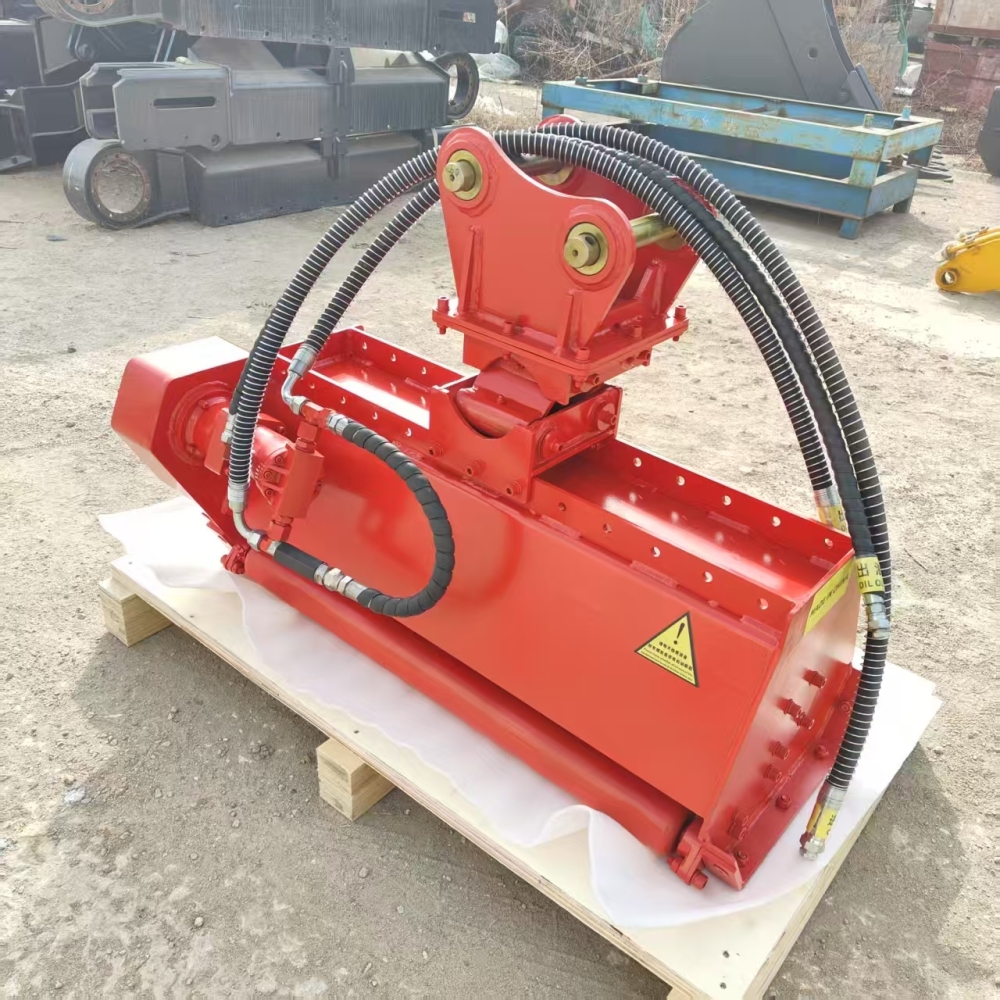
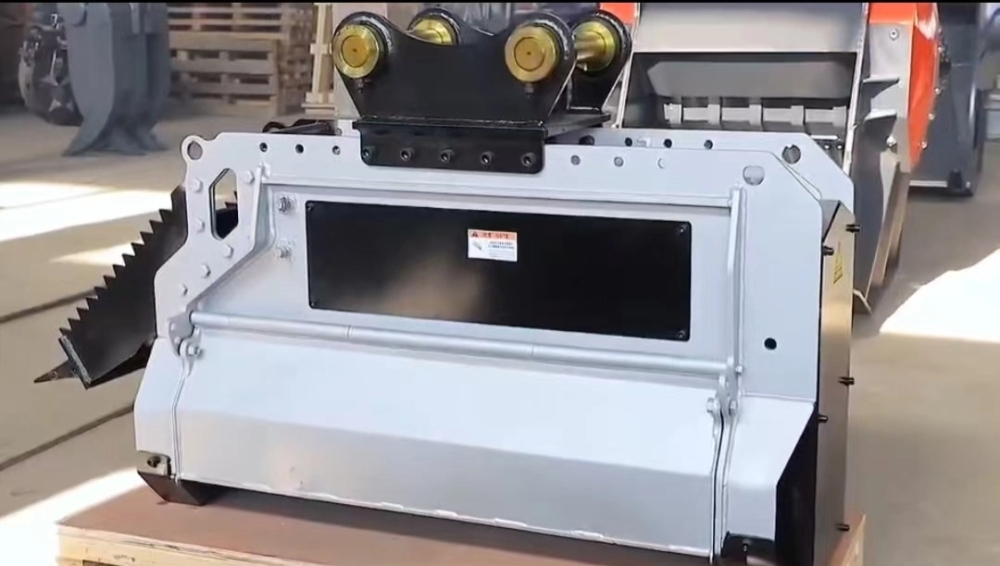
Rotary Drum/Roller Assembly: The primary working structure, consisting of a heavy-duty steel drum (diameter: 500–1,200 mm) embedded with multiple cutting tools. For standard applications, 26–40 cubit knives or alloy blades are evenly spaced to ensure continuous chopping; high-performance models use tungsten carbide-tipped (WC-Co alloy) blades for enhanced wear resistance against hardwoods like oak or coconut palms. The drum features concave inlays with spacing between blades, allowing chips to be 甩出 (ejected) smoothly via centrifugal force and preventing clogging—critical for processing wet or fibrous vegetation.
Working Width Configuration: Available in widths from 1,000 mm to 2,100 mm to match excavator size. A 1,000 mm wide drum (for 9–13 ton excavators) balances maneuverability and coverage, while 2,100 mm models (for 20–30 ton excavators) maximize area efficiency in large-scale land clearing.
High-Torque Hydraulic Motor: Powers the rotary drum using the excavator’s auxiliary hydraulic system. Axial piston or variable-displacement motors are common, operating at 20–25 MPa (200–250 bar) and requiring 60–120 L/min of hydraulic flow. High-end models like the ProGrind Pro 50 series integrate a 440-HP auxiliary engine to supplement power for grinding large-diameter trunks. The motor drives the drum at 1,500–3,000 rpm, with variable speed control to optimize torque for small brush (high speed) or thick trunks (low speed, high torque).
Pressure Regulation Components: Equipped with relief valves to prevent motor damage from overloading (e.g., when encountering rocks hidden in vegetation). Check valves maintain drum position during sudden pressure drops, ensuring operational stability.
Universal Mounting Bracket: Designed to fit excavator quick-couplers (ISO 13031) or pin-on linkages, with reinforced gussets (15–25 mm thick) to absorb vibration from high-speed rotation. Optional custom mounts are available for backhoe or sidearm booms, expanding compatibility beyond standard excavators.
Protective Structures: A heavy-duty steel housing surrounds the drum to contain flying debris, while side-mounted chain guards add an extra layer of safety for operators and bystanders. The frame uses Q355B high-strength steel with epoxy zinc-rich coating to resist corrosion from outdoor exposure and organic residues.
The excavator’s hydraulic pump supplies high-pressure oil to the attachment’s motor, driving the rotary drum at high speed. When the drum contacts vegetation:
Initial Cutting: Blades or knives slice through trunks/branches, with concave drum inlays guiding materials toward the cutting edge.
Size Reduction: Continuous rotation chops materials into small fragments, while centrifugal force (generated by the drum’s high rpm) ejects chips outward—preventing accumulation and clogging.
Pressure Adaptation: Variable-displacement motors adjust speed and torque automatically: for thin brush, the drum accelerates to 3,000 rpm for fast clearing; for 300+ mm diameter trunks, it slows to 1,500 rpm to maintain cutting force without stalling.
Positioning: The excavator maneuvers to the target vegetation, extending its arm to align the chipper drum with the base of the tree/brush (ideal height: 10–50 mm above ground).
Grinding Initiation: The operator activates the hydraulic motor to reach full drum speed, then feeds the drum into the vegetation—applying steady downward pressure for trunks or lateral movement for dense brush.
Continuous Processing: For tall trees, the excavator lifts the attachment incrementally to grind from base to canopy; for scattered brush, the wide drum covers 1–2 meters per pass.
Chip Dispersal: Chips are ejected directly onto the ground as mulch (aids soil moisture retention) or collected via optional augers for transport.
Key Features: For 6–9 ton excavators, with a 800–1,000 mm working width and 380–490 kg weight. Equipped with 20–26 alloy blades and operates at 2,500–3,000 rpm, handling trunks ≤150 mm diameter and shrubs.
Application Scenarios: Residential landscaping (yard waste clearing), small farm maintenance (orchard pruning), and municipal park upkeep. A 9-ton excavator-mounted model can clear 300–500 m² of light brush per hour.
Key Features: 适配 (Suitable for) 9–20 ton excavators, 1,000–1,400 mm working width, and 490–800 kg weight. Uses tungsten carbide blades and variable-displacement motors, processing trunks ≤300 mm diameter and dense hardwood brush.
Application Scenarios: Roadside vegetation management, forestry thinning, and coconut palm renewal in plantations. Ideal for slopes and riverbanks where mobility is critical.
Key Features: For 20–30 ton excavators, 1,400–2,100 mm working width, and 800–1,500 kg weight. Integrates high-horsepower auxiliary engines (up to 440 HP) and reinforced drums, grinding trunks ≤600 mm diameter and mature trees.
Application Scenarios: Large-scale land development (construction site clearing), disaster cleanup (storm-damaged trees), and industrial forestry operations. A 30-ton excavator-mounted model can process 10–15 mature trees per hour.
Time Savings: Manual clearing of a 1,000 m² area with dense brush takes 3–5 workers 2–3 days; a medium-duty chipper completes the task in 4–6 hours—reducing time by 80%. Grinding a 300 mm diameter trunk manually requires 30–45 minutes, while the attachment finishes in 60–90 seconds.
Reach and Access: The excavator’s extendable arm allows the chipper to reach 8–15 meters high, eliminating the need for ladders or aerial lifts when processing tall tree canopies.
Multi-Material Compatibility: Handles hardwoods, softwoods, shrubs, and even fibrous plants like coconut palms—replacing separate tools for pruning, felling, and chipping.
Sustainable Processing: On-site chipping turns waste vegetation into mulch, reducing landfill waste and improving soil health by retaining moisture and suppressing weeds. This eliminates transport costs for wood waste removal.
Reduced Injury Risks: Operators control the attachment from the excavator cab (3–10 meters from the work area), avoiding exposure to flying debris and manual lifting strain. Safety guards and chain barriers lower accident rates by 95% compared to handheld tools.
Equipment Cost Efficiency: Integrating with existing excavators eliminates the need to purchase standalone chippers (which require separate transport and operation). Maintenance costs are 30–40% lower than mobile chippers due to simplified hydraulic integration.
Weight and Power: The chipper’s weight should not exceed 20% of the excavator’s operating weight (e.g., a 10-ton excavator uses a ≤2-ton chipper) to avoid lift arm sag and excessive fuel consumption. Hydraulic flow and pressure must match the motor’s requirements (60–120 L/min, 20–25 MPa); insufficient flow causes slow rotation and inefficient chipping.
Reach Compatibility: For high-reach tasks, ensure the excavator’s arm length complements the chipper’s working width—e.g., a 12-meter arm pairs with a 1,400 mm wide drum for optimal coverage.
Blade Care: Inspect blades daily for dullness or damage. Sharpen alloy blades every 50 hours and replace tungsten carbide tips when wear exceeds 3 mm. Balance the drum after blade replacement to reduce vibration.
Hydraulic System Checks: Examine hoses and couplings weekly for leaks; replace damaged hoses with 40 MPa-rated steel-braided versions. Change hydraulic oil filters every 1,000 hours and use ISO VG 46 oil for optimal motor performance.
Frame and Guard Maintenance: Grease pivot points every 40 hours with lithium-based grease (NLGI 2). Clean debris from the drum housing after each use to prevent corrosion and clogging.
Pre-Operation Inspection: Lower the chipper to the ground, shut off the excavator, and relieve hydraulic pressure before checking blades or guards. Never reach into the drum housing—residual rotation can cause injury.
On-Site Protocols: Maintain a 10-meter safety radius around the working area. Avoid operating near overhead power lines (minimum 5-meter clearance) and never process material containing metal (e.g., nails in branches) to prevent blade damage. Cease operation in high winds (≥50 km/h) to avoid unpredictable debris flight.