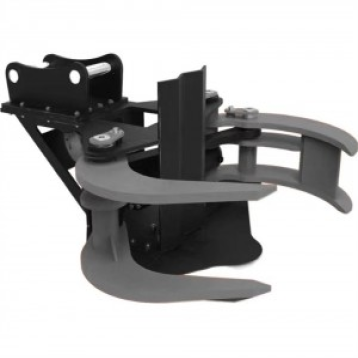


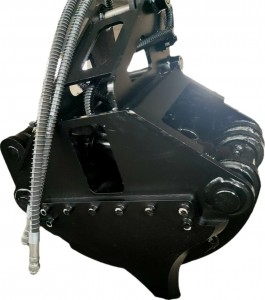


Excavator Tree Cutting Machine
The Excavator Tree Cutting Machine is a specialized hydraulic attachment engineered for excavators, dedicated to efficient cutting, trimming, and felling of trees, shrubs, and woody vegetation. Unlike standalone chainsaws or manual tools, it integrates high-torque cutting mechanisms with the excavator’s mobility and reach—enabling operations on tall trees (up to 15 meters), dense thickets, or hard-to-access areas (e.g., slopes, wetlands). This design makes it a core tool in forestry management, urban greening, land development, and disaster cleanup (e.g., post-storm tree removal). By leveraging the excavator’s hydraulic system, it delivers adjustable cutting force (5–30 kN) to handle trunk diameters from 100 mm (shrubs) to 800 mm (mature trees), replacing labor-intensive manual felling and reducing operation time by 60–80%.1. General Definition and Core Function
The Excavator Tree Cutting Machine is a specialized hydraulic attachment engineered for excavators, dedicated to efficient cutting, trimming, and felling of trees, shrubs, and woody vegetation. Unlike standalone chainsaws or manual tools, it integrates high-torque cutting mechanisms with the excavator’s mobility and reach—enabling operations on tall trees (up to 15 meters), dense thickets, or hard-to-access areas (e.g., slopes, wetlands). This design makes it a core tool in forestry management, urban greening, land development, and disaster cleanup (e.g., post-storm tree removal). By leveraging the excavator’s hydraulic system, it delivers adjustable cutting force (5–30 kN) to handle trunk diameters from 100 mm (shrubs) to 800 mm (mature trees), replacing labor-intensive manual felling and reducing operation time by 60–80%.
2. Key Structural Components
2.1 Cutting Mechanism (Core Working Unit)
Chain Saw Head (Common Type): Adopts a high-strength guide bar (length: 500–1,200 mm) made of manganese steel (65Mn) with a hardness of HRC 45–50, ensuring resistance to bending during cutting. The saw chain uses carbide-tipped teeth (WC-Co alloy) to enhance wear resistance—suitable for cutting hardwoods (e.g., oak, maple) with a Mohs hardness of 3–4. The chain speed ranges from 8–15 m/s, controlled by a hydraulic motor (displacement: 50–150 mL/r) operating at 25–35 MPa. For example, a 10-ton excavator-mounted saw head can cut a 300 mm diameter pine trunk in 10–15 seconds.
Circular Saw Head (Heavy-Duty Type): Equipped with a steel blade (diameter: 600–1,500 mm) with tungsten carbide inserts (tooth count: 12–24). The blade is driven by a planetary gear reducer connected to a hydraulic motor, delivering a torque of 500–2,000 N·m. This type is ideal for thick trunks (≥500 mm diameter) or hardwoods, as the circular blade reduces vibration and ensures smooth cuts—avoiding chain jamming common in dense wood.
2.2 Hydraulic Drive System
Cutting Motor: For chain saw heads, a low-speed high-torque (LSHT) hydraulic motor (rotational speed: 800–1,500 rpm) provides consistent power to the saw chain. For circular saw heads, a high-torque motor (rotational speed: 300–600 rpm) paired with a reducer ensures the blade maintains cutting force without stalling. Both motor types use nitrile rubber seals to prevent oil leakage and dust intrusion, suitable for outdoor and humid environments.
Tilt/Rotation Cylinders (Optional): Advanced models integrate 1–2 hydraulic cylinders for vertical tilt (±45°) and 360° horizontal rotation. The tilt cylinder (bore diameter: 40–80 mm) adjusts the cutting angle to handle sloped trunks, while the rotation motor (displacement: 200–500 mL/r) allows the saw head to reach trees at any orientation—eliminating the need to reposition the excavator.
2.3 Extension Arm (Reach Enhancement Component)
Telescopic Arm: For cutting tall trees (8–15 meters), a 2–4 section telescopic arm (made of Q690 high-strength steel) extends the saw head’s reach. Each section is driven by a hydraulic cylinder (bore diameter: 60–100 mm) with a stroke of 1,000–2,000 mm, ensuring stable extension under load. The arm’s surface is coated with anti-corrosion paint (epoxy zinc-rich primer) to withstand outdoor weathering.
Fixed Arm (Standard Type): For medium-height trees (3–8 meters), a fixed arm (length: 2–4 meters) made of Q355B steel is used. It is lighter than telescopic arms (weight: 300–800 kg) and has a simpler structure—reducing the load on the excavator’s main arm.
2.4 Mounting and Safety Components
Mounting Bracket: Designed to match the excavator’s quick-coupler (ISO 13031) or pin-on linkage. The bracket is reinforced with gussets (thickness: 15–25 mm) to withstand cutting vibration, and precision-drilled to ensure alignment with the excavator’s arm—reducing stress on the linkage.
Safety Guards: A steel plate guard (thickness: 5–8 mm) surrounds the saw chain/blade to prevent debris from flying outward. For chain saw heads, a chain brake is installed—activating automatically if the chain jams or the motor stalls, preventing chain breakage and operator injury.
3. Working Principle
3.1 Hydraulic Power Transmission
The excavator’s auxiliary hydraulic pump supplies high-pressure oil (25–35 MPa) to the cutting motor and optional tilt/rotation components. The operator controls the oil flow via a dedicated lever:
For chain saw heads: Pushing the lever activates the motor, driving the saw chain; adjusting the lever position controls chain speed (8–15 m/s) based on trunk thickness.
For circular saw heads: The lever controls both motor speed and blade feed rate (50–100 mm/s), ensuring the blade cuts through wood without overheating.
For tilt/rotation functions: Secondary levers adjust the cylinder/motor to position the saw head at the optimal cutting angle.
3.2 Typical Operation Process
Positioning and Reach Adjustment: The operator maneuvers the excavator to within 2–5 meters of the target tree, then extends the telescopic/fixed arm to align the saw head with the desired cutting height (e.g., 0.5–1.5 meters above ground for felling, 2–5 meters for trimming).
Cutting Preparation: The saw chain/blade is activated to reach full speed. For felling, the operator first makes a "notch cut" (45° angle, 1/3 trunk depth) on the side of the tree facing the desired fall direction.
Trunk Cutting: For chain saw heads, the saw chain is pressed against the trunk to penetrate wood—applying steady pressure to avoid jamming. For circular saw heads, the blade is fed into the trunk at a 90° angle to the notch cut. A 300 mm diameter trunk takes 10–20 seconds to cut through.
Tree Handling (Optional): After felling, some models use a integrated grapple (mounted above the saw head) to grip the trunk and move it to a collection area—eliminating the need for a separate grab attachment.
Trimming (Shrubs/Tall Trees): For thickets, the saw head is tilted horizontally to trim multiple shrubs in a single pass. For tall trees, the telescopic arm extends to cut upper branches, with the rotation function adjusting the saw head to reach overhanging limbs.
4. Classification by Application
4.1 Light-Duty Tree Cutting Machine
Key Features: Designed for mini-excavators (1–5 tons), with a chain saw head (guide bar length: 500–700 mm) and fixed arm (length: 2–3 meters). The cutting motor generates 5–10 kN of force, suitable for trunks ≤200 mm diameter. Weight: 200–400 kg, no tilt/rotation functions.
Application Scenarios: Urban greening (trimming park shrubs, cutting small street trees), residential landscaping (removing backyard trees), and municipal maintenance (clearing roadside overgrowth). A 3-ton excavator-mounted light-duty machine can cut 20–30 small trees (≤150 mm diameter) per hour.
4.2 Medium-Duty Tree Cutting Machine
Key Features: For mid-sized excavators (5–15 tons), available with chain saw (guide bar: 700–1,000 mm) or circular saw (diameter: 600–1,000 mm) heads. Equipped with a tilt cylinder (±30°) and fixed arm (length: 3–4 meters). Cutting force: 10–20 kN, handling trunks ≤400 mm diameter.
Application Scenarios: Forestry thinning (removing young trees in dense forests), land development (clearing vegetation for construction sites), and highway maintenance (trimming trees along road shoulders). A 10-ton excavator-mounted medium-duty machine can cut 15–25 trees (200–400 mm diameter) per hour.
4.3 Heavy-Duty Tree Cutting Machine
Key Features: For large excavators (15–30 tons), with a circular saw head (diameter: 1,000–1,500 mm) and telescopic arm (reach: 8–15 meters). Integrates 360° rotation and ±45° tilt, with a cutting force of 20–30 kN—handling trunks ≤800 mm diameter. The saw blade uses extra-thick carbide inserts (5–8 mm) for hardwoods.
Application Scenarios: Mature forest felling (cutting large pine/oak trees), disaster cleanup (removing storm-damaged trees), and industrial land clearing (clearing dense forests for factories). A 25-ton excavator-mounted heavy-duty machine can cut 8–12 large trees (400–800 mm diameter) per hour.
4.4 Specialized Shrub Cutting Machine
Key Features: Optimized for dense shrubs, with a multi-chain saw head (3–5 parallel chains) or a rotating brush cutter (blade diameter: 800–1,200 mm). The fixed arm is short (2–3 meters) for maneuverability, and the cutting motor operates at high speed (1,200–1,800 rpm) to shred branches ≤100 mm diameter.
Application Scenarios: Wetland restoration (clearing invasive shrubs), agricultural land preparation (removing hedgerows), and wildfire prevention (creating fire-break zones by clearing vegetation). A 8-ton excavator-mounted shrub machine can clear 500–800 m² of dense shrubs per hour.
5. Practical Applications and Advantages
5.1 Efficiency Improvement in Vegetation Management
Time Savings: Manual felling of a 300 mm diameter tree takes 15–25 minutes (with 2 workers), while the machine completes the task in 10–15 seconds—reducing operation time by 90%. For a 10-hectare forest thinning project, manual work takes 30–45 days, while the machine finishes in 5–8 days.
Reach Enhancement: The telescopic arm (up to 15 meters) eliminates the need for ladders or aerial work platforms when cutting tall trees—saving 30–50% of time compared to aerial cutting methods.
5.2 Safety and Environmental Benefits
Reduced Injury Risks: Operators control the machine from the excavator cab (3–10 meters away from the tree), avoiding risks of falling branches, chain kickback, or manual lifting injuries. Statistics show the machine reduces tree-cutting injury rates by 95% compared to manual tools.
Precision Cutting: The tilt/rotation functions enable selective cutting (e.g., removing only diseased trees in a forest) without damaging adjacent vegetation—critical for ecological conservation areas or urban parks with mature trees.
5.3 Cost Savings and Versatility
Labor Reduction: A single machine (operated by 1 worker) replaces a team of 3–4 manual cutters, reducing annual labor costs by
100,000 for forestry companies.
Multi-Task Adaptability: With interchangeable saw heads (chain/circular) and optional grapples, the machine handles felling, trimming, and material handling—eliminating the need to purchase separate attachments (saving 40–60% of equipment costs).
6. Operational and Maintenance Considerations
6.1 Excavator Matching Requirements
Weight and Power: The machine’s weight (200–2,000 kg) should not exceed 20% of the excavator’s operating weight (e.g., a 5-ton excavator should use a machine ≤1 ton). The excavator’s auxiliary hydraulic flow should be 20–60 L/min (matching the cutting motor’s flow requirement)—insufficient flow causes slow cutting, while excessive flow overheats the motor.
Reach Compatibility: For telescopic arm models, ensure the excavator’s main arm can support the extended weight (e.g., a 15-ton excavator can handle a 4-meter telescopic arm with a 500 kg saw head).
6.2 Routine Maintenance
Cutting Component Care: For chain saw heads, lubricate the saw chain with bar oil every 30 minutes of operation—check chain tension (10–15 mm sag) and replace worn teeth (when tips are rounded). For circular saw heads, sharpen the carbide inserts every 50 cuts (using a diamond grinding wheel) and check blade balance to avoid vibration.
Hydraulic System Inspection: Check hoses and couplings for leaks weekly—replace damaged hoses (rated for 40 MPa) to prevent pressure loss. Change the auxiliary hydraulic oil filter every 1,000 operating hours and use oil meeting ISO VG 46 standards.
Arm and Bracket Maintenance: Grease the telescopic arm cylinders and rotation joints every 8 hours (using lithium-based grease NLGI 2). Inspect the mounting bracket for cracks monthly—weld small cracks with E5015 electrodes.
6.3 Safety Operation Rules
Operator Training: Operators must complete training on saw head operation, tree felling mechanics (e.g., notch cut angles), and emergency procedures (e.g., stopping the saw if the tree leans unexpectedly). They should also understand weather limits—avoid cutting in high winds (≥50 km/h) to prevent falling tree instability.
On-Site Safety: Before operation, clear the area of personnel (minimum 10-meter radius) and check for overhead power lines—keep the saw head at least 5 meters away from live wires. For felling, plan the tree’s fall direction to avoid obstacles (e.g., buildings, roads) and use a rope to guide the tree if needed.