


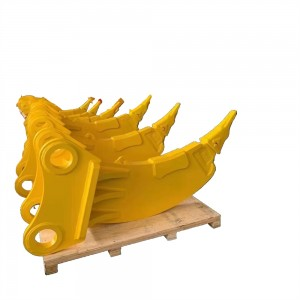


Other Customized Attachment Products
Customized attachment products play a vital role in expanding the multifunctional application scenarios of excavators. They can accurately meet the needs of various complex working environments and special tasks.1. Customized Accessories for Crushing, Screening, and Sorting
Crushing buckets: Designed specifically for processing materials such as construction waste and waste concrete. They feature crushing plates made of high-strength alloy steel. Driven by an eccentric shaft driven by a hydraulic motor, the plates compress, shear, and split the material at a specific frequency. For example, for the large quantities of concrete blocks generated during urban demolition projects, a customized crushing bucket can adjust the spacing between the crushing plates and the hydraulic system pressure based on the size and hardness of the blocks, crushing them to the desired particle size (e.g., 5-50mm) for subsequent recycling or transportation. This crushing bucket is compatible with excavators ranging from 10 to 30 tons, significantly improving the efficiency of construction waste processing by up to 8-10 times compared to traditional manual crushing methods.
Screening buckets: Primarily used for grading and screening excavated soil, sand, and gravel. It is equipped with stainless steel screens of varying apertures (such as 10mm, 20mm, and 30mm). A hydraulically driven vibrating motor generates high-frequency vibrations, causing the material to bounce on the screen and pass through the corresponding apertures for classification. During post-mining ore screening operations, the screening bucket quickly separates the mined mixed ore by particle size, transporting the qualified ore directly to subsequent processing. This improves overall mining efficiency and reduces ore waste during transportation and storage.
2. Customized Material Handling Accessories
Multi-function Grapple: This attachment combines grabbing, handling, and loading and unloading functions. Made of high-strength manganese steel, it features a variety of tine designs, such as sharp tines for grabbing wood and flat tines for handling bulk materials. In timber processing plants, multi-functional grabs can easily grab and move logs, planks, and other materials. The grab's opening and closing angles can be precisely controlled by hydraulic cylinders, and its gripping force can reach 10-30 kN. This allows for handling timber of varying sizes and weights. Compared to traditional forklifts, it can adapt to more complex environments and improves handling efficiency by 30%-50%.
Forklift attachments: Excavators are converted into forklifts, using customized forklift attachments to lift and move cargo. Forklift lengths can be customized to meet operational needs, typically ranging from 2-5 meters, with a maximum lifting capacity of 5-10 tons. In logistics warehouses or construction sites, forklift attachments can be used to move palletized cargo, building materials, and other materials. They can maneuver flexibly through confined spaces, addressing the site adaptability limitations of traditional forklifts and providing an efficient and flexible solution for cargo handling.
3. Customized Ground Handling Attachments
Milling Machines: Used for milling pavement and other surfaces. The milling drum is equipped with a carbide milling cutter head, which rotates at high speed via a hydraulic motor to cut the ground. In urban road maintenance projects, the milling machine can adjust the milling depth (typically between 5 and 100 mm) based on the degree of road damage, precisely removing damaged layers, rutting, and other road surfaces, creating optimal conditions for subsequent road repair work. Customized milling machines can be adapted to different excavator models, with working widths typically ranging from 0.5 to 2 meters, greatly improving the flexibility and efficiency of road milling operations.
Compactor: For backfilling and foundation treatment operations, customized compactors use hydraulic drive to generate high-frequency impact force to compact the ground. They utilize specially designed rammers whose weight and drop height can be adjusted according to soil type and compaction requirements. For example, in building foundation treatment, they can achieve backfill compaction levels exceeding 90%, ensuring foundation stability and load-bearing capacity. Compactors have obvious advantages in compaction operations in narrow sites or complex terrain. Compared with traditional frog-type rammers, they can increase work efficiency by 2-3 times.
